Forex Scams in Nigeria: How to Spot Them and Check a Licence
If a forex offer promises easy income, treat it as a scam until the SEC Nigeria register proves otherwise.
Updated Oct 2026 · how we rate brokers
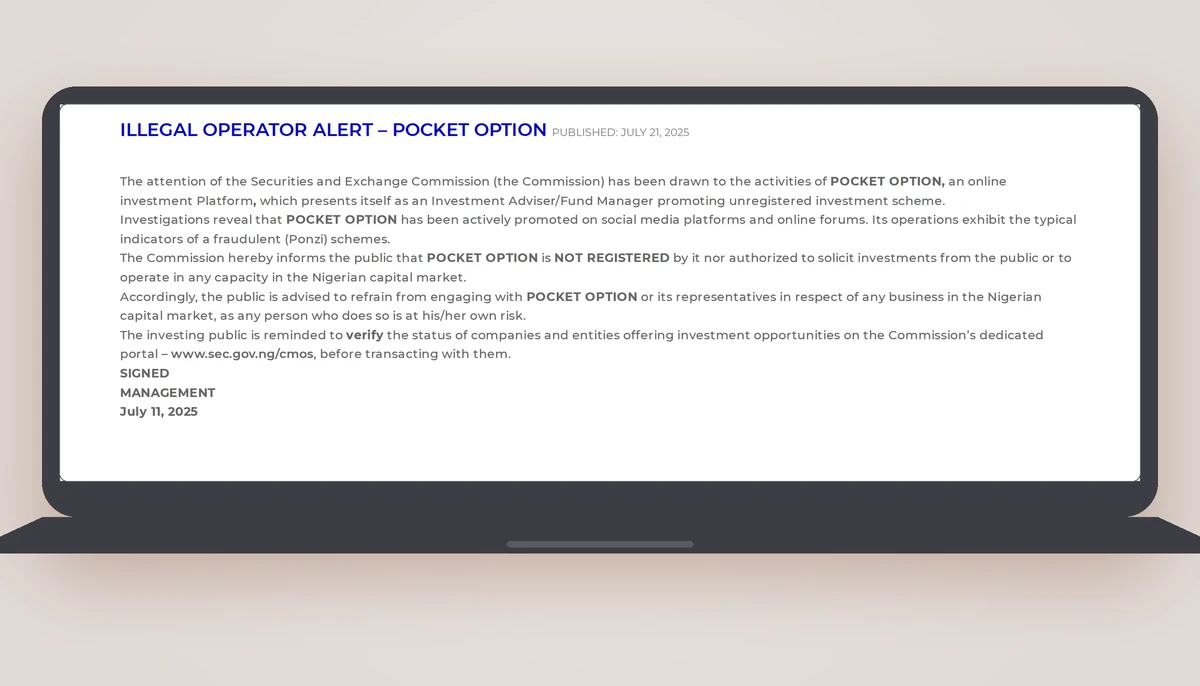
The promise of easy income is the scam's first clue
Real forex trading is a risk business, not an income scheme. Anyone who tells you a monthly return is guaranteed, or that a robot or account manager will trade for you while you sleep, is selling a story rather than a service. The Central Bank of Nigeria has warned the public about fraudulent forex schemes, and the pattern is always the same: small early payouts to build trust, then a request for more.
In Nigeria the money usually moves by bank transfer, OPay, PalmPay, Moniepoint, card or USSD transfer. That is convenient for you and for the person collecting it. Once a transfer leaves your bank app, recovery is difficult, so the check has to happen before you send, not after.
Before you send money
- A fixed monthly return, promised in advance
- Ask which licence permits it, then look the firm up on the SEC Nigeria register of capital market operators.
- A deposit asked for in gift cards or vouchers
- Check the broker's own funding page: firms list bank, card and wallet rails, not vouchers.
- Someone offering to trade the account for you
- Managing money for a client is a separate permission. The register says whether a firm holds it.
- A withdrawal released only after a new payment
- Read the withdrawal terms you agreed to. A fee invented at payout time is not in them.
None of this is a judgement about any firm. Each line is a check you can run yourself, starting at sec.gov.ng.
Check the SEC Nigeria register before you fund anything
The Securities and Exchange Commission of Nigeria keeps a public register of capital market operators at sec.gov.ng. Search the exact name on the register and read what the entry actually covers. If the name does not appear, that is your answer, regardless of how polished the website looks or how many people in a Telegram group say they have been paid.
A screenshot of a certificate proves nothing. Registers change, and a certificate can be edited or belong to a different company. Go to sec.gov.ng yourself, type the name, and check whether the entity you are about to pay is the same legal name on the register. If the app or website uses a different name from the one you searched, stop and ask why.
Do not rely on the platform's own 'regulation' page. Anyone can write that page. The register is the only check that matters, and it takes a few minutes on your phone.
| Field | What it says |
|---|---|
| Regulator | Securities and Exchange Commission of Nigeria (SEC Nigeria) |
| Register | SEC Nigeria register of capital market operators |
| Published at | sec.gov.ng |
| Covers retail forex | No category for an online leveraged FX broker |
| Last read by us | 2026-10-10 |
| Entries transcribed here | 320 |
A register says whether a firm holds a licence on the day you look, and nothing about how it treats clients. Search the legal entity from the broker's own footer, not the brand.
The local patterns that keep repeating
Account manager scams are the most common. Someone contacts you on WhatsApp or Telegram, offers to trade your money for a share of profits, and asks you to transfer funds to a personal or company account. There is no trade, only a transfer. When you ask to withdraw, you are told to pay a fee or tax first. That request for more money to release your own money is the clearest sign you have been defrauded.
Signal group scams sell certainty. A group posts winning screenshots, then charges for a 'premium' channel. Screenshots are easy to fake and past wins say nothing about future results. No one selling signals can remove the risk from trading.
Fake app scams clone the look of a known platform and take deposits through the same Nigerian rails. The app shows a rising balance that does not exist. Before you install anything, check the developer name and compare it with the register entry.
| Rail | What it is | Who sets the limit and the fee |
|---|---|---|
| Bank transfer · used most | Bank transfer | Your bank and the broker |
| OPay | Payment service | The provider and the broker |
| PalmPay | Payment service | The provider and the broker |
| Moniepoint | Payment service | The provider and the broker |
| Card | Card payment | Your card issuer and the broker |
| USSD transfer | Bank channel | Your bank and the broker |
Limits and fees are set by the provider and the broker and change without notice, so they are not printed here. Fees are stated in two places - your provider's app and the broker's funding page - and the payout belongs on the account that paid in.
Risk management is the part no scammer will teach you
Risk management in forex means deciding in advance how much of your account you are willing to lose on a single trade, and sizing the position so that loss stays within that limit. It is the opposite of the message scams sell, which is that you cannot lose. A risk calculator for forex helps you turn that decision into a position size instead of guessing.
The session hours matter for Nigerian traders because they set when the market is actually liquid. Sydney runs 22:00 to 07:00 WAT, Tokyo 01:00 to 10:00 WAT, London 09:00 to 18:00 WAT, and New York 13:00 to 22:00 WAT. The London and New York overlap, 13:00 to 18:00 WAT, is when the most activity usually happens. Thin hours can mean wider moves on smaller volume.
Use the calculator on this site for the arithmetic, and check the broker's own funding page for what it charges to deposit and withdraw. If a platform cannot show you those costs clearly, that is information too.
| Figure | Source | Checked |
|---|---|---|
| Licensee names and status | SEC Nigeria register of capital market operators — sec.gov.ng | 2026-10-10 |
| Session windows | Fixed UTC windows; London and New York shift in their DST | On change |
| USD/NGN | open.er-api.com | 2026-09-28 |
| Funding limits and fees | Set by the provider and the broker — not published here | Changes without notice |
We would rather show a gap than a number we cannot stand behind, so untraceable figures are simply not printed.
A short checklist before you send money
Search the exact name on the SEC Nigeria register at sec.gov.ng. Confirm the name you are paying matches the name you searched. Read the broker's funding page for deposit and withdrawal terms. Check that withdrawals are handled by the platform itself and not by a 'manager' on WhatsApp. If anyone asks you to pay a fee to release a withdrawal, treat the account as lost and report it.
Keep your bank app open while you do this. The transfer is the point of no return, and the check costs you nothing but a few minutes.
| Figure | Value | Source |
|---|---|---|
| Indicative USD/NGN | 1 327.30 | open.er-api.com, pulled 2026-09-28 |
| How often it moves | Every trading day | — |
| The rate your account uses | Your broker's own conversion | The broker's rate card |
| Symbol on this site | ₦ | — |
An indicative rate is for sizing a position in your head, not for settling one. Between this rate and the broker's conversion there is a margin, and it comes out of the trade.
A register entry names the firm, not the person messaging you
Scammers often borrow the name of a genuine registered operator, then contact you from a different phone number, WhatsApp account or Telegram handle. The register at sec.gov.ng tells you whether a named firm holds a licence. It does not verify the stranger who sent you the message, so treat the two as separate questions.
Ask the firm directly, using contact details you found yourself rather than any link or number the sender gave you. Confirm whether that person works there and whether they are authorised to open accounts or receive funds. A real representative will not object to this. A scammer will invent a reason to hurry you past it.
The failure mode is simple. The licence is real, the firm is real, and the money still goes to a fraudster who never worked there. The register check protects you against unlicensed firms, not against impersonation. Both checks are needed before any transfer leaves your account.
| Document | What it proves |
|---|---|
| NIN slip or passport | Who you are |
| Selfie with the ID document | That the document is in your hands |
Brokers usually also ask for BVN, proof of address; requirements differ per firm. Look at the opening page of the broker you chose: that is the list that applies to you.
Where your money actually goes when you fund an account
Legitimate funding normally moves from your own bank account to an account in the broker's registered name, and the details appear inside the broker's own platform or app. If the destination is a personal name, a random business name, or an individual's OPay, PalmPay or Moniepoint wallet, that is a serious warning sign, whatever the licence check showed.
Scammers prefer wallets and USSD transfers because they clear fast and are hard to reverse. Bank transfers to a corporate account leave a clearer trail and give your bank something to act on. Before sending, open your bank app and read the account name it displays. If it does not match the firm you believe you are funding, stop.
Keep the receipt, the session details and the chat history. Nigerian banks and the SEC Nigeria both ask for a paper trail when a complaint is filed. Readers who paid by wallet transfer with no record often have the weakest case. The order matters: verify the account name first, then send, then keep everything.
| Platform | What it is | Who makes it |
|---|---|---|
| MetaTrader 4 | The older standard; expert advisors and a large script ecosystem | MetaQuotes |
| MetaTrader 5 | The newer build; more order types and timeframes | MetaQuotes |
| cTrader | Depth of market and a different order model | Spotware |
| The broker's own app | Usually simpler, and tied to that one firm | The broker |
A platform is software, not a safeguard: the same terminal is offered by licensed and unlicensed firms alike. An app store listing says nothing about a licence; the register does.
Recovery offers are the second wave of the same scam
After money is lost, a new contact often appears promising to retrieve it. They may claim to be a recovery agent, a lawyer, or someone connected to the regulator. They ask for an upfront payment, a release fee or your bank details. No genuine recovery process begins with you paying a stranger to get your own money back.
The SEC Nigeria register lists capital market operators. It is not a list of recovery firms, and no one on it will cold-call you to reverse a transfer. Genuine help comes from your own bank's fraud desk, the police, and the SEC Nigeria complaint channels you look up yourself at sec.gov.ng.
This second wave works because the first loss already proved you will send money under pressure. The same urgency, the same private channel, the same promise of a quick fix. Treat any unsolicited recovery offer as a fresh scam and report it, rather than paying to chase the original loss.
When the market is worth sitting down for (WAT)
- Busiest window
- 13:00-18:00 WAT — London and New York open together
- Thinnest stretch
- 22:00-07:00 WAT — Sydney alone, wider spreads
- European open
- 09:00-18:00 WAT
- US open
- 13:00-22:00 WAT
- Closed
- Friday New York close until the Sydney open on Monday
The clocks in force today are shown as follows: GMT applies in London until 28 March, while EDT applies in New York until 1 November. Nigeria does not change clocks, so each move shifts these local times by an hour and the page is rebuilt on the day it happens.
Is forex trading legit in Nigeria?
Trading foreign exchange is a real market activity, but that says nothing about the platform you are using. Legitimacy sits with the specific firm, so check the exact name on the SEC Nigeria register at sec.gov.ng before you fund an account. If the name is not there, do not send money.
Is Headway broker legit?
No guide can confirm a broker's status for you, and you should not take anyone's word for it either. Search the exact name on the SEC Nigeria register at sec.gov.ng and read the entry yourself. If the name does not appear, or the entity you are paying differs from the one on the register, walk away.
What is risk management in forex?
It means fixing in advance how much of your account you will risk on one trade, then sizing the position so a loss stays inside that limit. A forex risk calculator turns that decision into a position size. No method removes risk, and anyone claiming otherwise is selling something.
Where to begin
The funding page for Nigeria explains the part that surprises people after they deposit.